
Today’s post comes from Penn Press’s Marketing Operations Manager, Tracy Kellmer, continuing a blog series in which Tracy explores one of the books currently for 75% off in the Franklin’s Faves section of our website! The Franklin’s Faves selection will rotate in early April, so be sure to pick up your copy of today’s featured book, The Fountain of Latona by Thomas F. Hedin (or any of the other great books currently available) ASAP—and use code FRANKLINSFAVES to receive your 75% discount!
What I picked:
The Fountain of Latona by Thomas F. Hedin
Why I picked it:
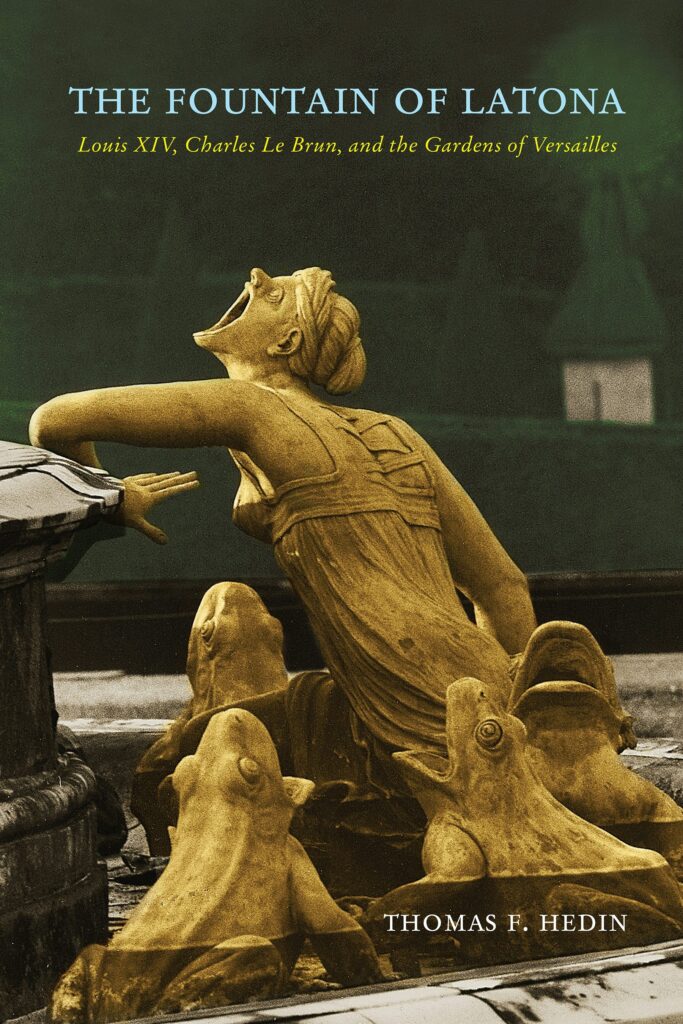
I admit it: I picked this book because of the cover. The expression of suffering and terror on the woman’s face, surrounded by frogs with raised faces and open mouths—I had to know what those sculptures were, where they were, and who made them! Reading the marketing copy gave me the where and the when: the garden of Versailles in the 1660s, and the names of the artist, Charles Le Brun, the architect, Andre Le Norte, and the sculptors, Gaspard and Balthazar Marsy. I also learned that the figure on the cover is part of a trio of fountains representing the story of Latona, the mother of Apollo and Diana, told by Ovid. Quoting from the copy:
In her flight from the jealous Juno, she arrives faint and parched on the coast of Asia Minor. Kneeling to sip from a pond, Latona is met by the local peasants, who not only deny her effort but muddy the water in pure malice. Enraged, Latona calls a curse down upon the stingy peasants, turning them to frogs.
I never had a formal education in either Classics or Art History, and I couldn’t think of a better way to get a crash course in both than by reading this book.
What I discovered:
The marketing copy also mentioned the “genius of the King’s hydraulic engineers,” and the top genius’s name was Denis Jolly. Under his supervision, the team in charge of transforming the King’s rough and ready hunting ground into the magnificent Garden of Versailles built multiple reservoirs, a pump station, and a vast network of piping and nozzles that compressed the water as it made its way to the fountains. All of this terraforming and mechanical engineering resulted in spectacular jets of water, not only in the center of the fountains but also along the outside rims. In fact, the water jets had to be planned and executed before any sculpture or artwork could be installed in the fountain basins!
It’s only fitting that the artwork adorning the central group of three fountains at the base of the chateau has a theme that would complement the literally groundbreaking technical work done to make the water do what men wanted it to do. Charles Le Brun and the Marsy brothers thought Ovid’s story about Latona made a fitting tribute to a King who, through his largesse, could control water and turn a dry landscape into a lush garden (rendering him as the god Jupiter, metaphorically).
But there was even more at stake for Le Brun and the Marsy brothers than simply an appropriately regal design for the fountains. Apparently in 1660, painting and sculpture were not considered “arts” like poetry and history, but merely “crafts.” The reason? Because a painting or a sculpture could not communicate a story, that is, convey a plot, and therefore could neither save for posterity—nor educate a populace—about a sequence of important events. Nor could painting and sculpture, as I understand the argument of the time, impart the “character” of the persons they depicted: from their social standing to their virtuousness to their emotional state. But Le Brun and Marsy, among others, sought to prove that painting and sculpture can do all of those things and more. By studying ancient Greek statues and paintings by the likes of Raphael and Poussin, they developed principles around volume and line, costume and facial expressions, and, last but not least, the position of each and every element in a scene, in order to connote the passage of time and a sequence of events.
When the fountain was completed, a person viewing them from the ideal position at the base of the stairs would have seen the peasants gradually turning into frogs—surrounded by frogs, which were probably once people—and encroaching on the central figure of Latona and her children. Le Brun’s principles would have dictated that Latona and her children be sculpted from marble, in slender volumes and with fine lines, and that Latona’s drapery be luxurious. The peasants were cast in metal, gilt with gold, and were stocky and dressed more modestly. Because of these aesthetic decisions, the story of divine punishment would have been clear.
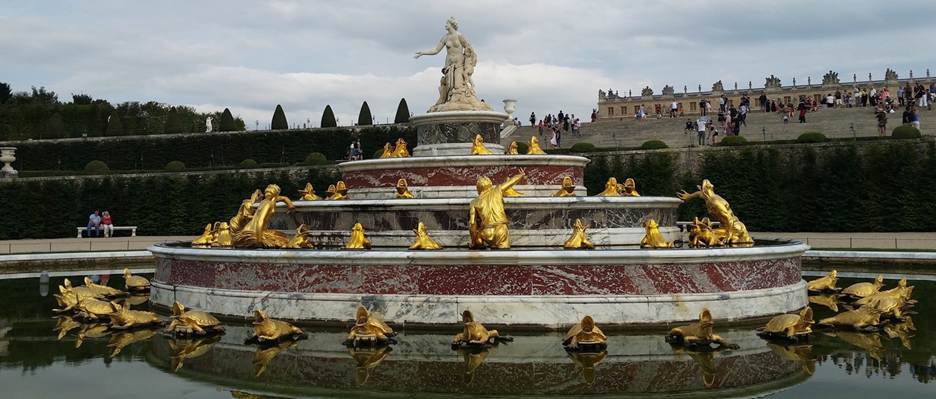
The original Latona fountain design only exists as a drawing by an eyewitness. When Le Brun was in charge of the fountain, his vision was bankrolled and fulfilled by Jean-Baptiste Colbert, who died in 1683. The garden was turned over to Colbert’s rival Michel Le Tellier and his supporters Pierre Mignard, Francois Girardon, and Jules Hardoin-Mansart. Needless to say, they had no appreciation for Le Brun’s design, considering it both tangential to their plans and expendable. Mansart reconfigured the Latona fountain in 1687, less than 20 years after it was completed, demonstrating that it takes more than artistic merit to have one’s work preserved for posterity. Mansart raised the marble statue of Latona and her children from just above the height of the water to the top of a pyramid of multi-colored marble platforms. He then repositioned the Lycean peasants, as well as the frogs, lizards, turtles, and other creatures from all three “Latona” fountains (see “my favorite bit,” below), regularly and randomly, on the tiers. By doing so, the gold-covered lead statues lost their meaning and were reduced to mere ornamentation. The worst part is that when viewed from the previous “ideal” viewing spot, Athena’s back is turned. What a rebuke of Le Brun and company’s vision by the incoming Versailles Park administration!
I didn’t know Ovid’s story about Latona before I read this book, and I have never seen the fountain. But I could tell immediately that the woman featured on the cover of the book—due to her twisted torso and dress, her bent arm, and her outstretched jaw—was clearly terrified, tortured, and despairing at her condition. And the frogs, though not contextually informed, added an even more creepy and horrific effect, in that her mouth was mirrored by theirs. And it’s still quite clear that the figures in the center were the “good guys” and the monstrosities surrounding them were the “bad guys,” directing either their vitriol or their pleas for mercy to the elevated and beautiful divine-like marble trio.
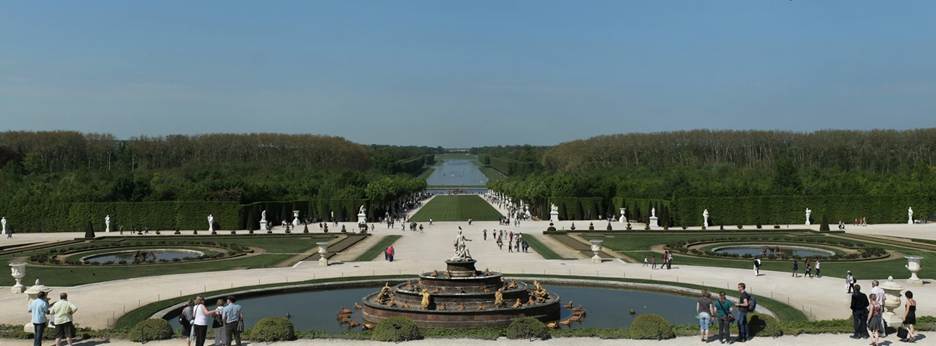
Although Le Brun’s and his collaborators’ aim in presenting a moment that represented a whole narrative was frustrated, their conviction that the aesthetic principles they gained from ancient Greek sculptures could inspire strong emotions and understanding on the part of the viewer has stood the test of time, even to this day, even to someone like me who, having never been there, has to rely on pictures (see below for two photos from the internet that shows what the fountain looks like today).
My favorite bit:
Latona’s fountain also has a parterre, which, according to Wikipedia, is “a part of a formal garden constructed on a level substrate, consisting of symmetrical patterns, made up by plant beds, plats, low hedges or colored gravels, which are separated and connected by paths.” Le Norte, Le Brun, and company designed two additional “lizard fountains” to flank the Latona fountain on either side. Extending the story of Ovid’s peasants to include the children of the peasants, which Ovid had originally not included, the lizard fountains featured a central water element and two children. All four children are clearly terrified and attempting to turn or run away from what’s happening in the central fountain. They are called the lizard fountains because they were originally encircled with not only frogs, but lizards, turtles, alligators, and other reptiles. The children were trapped by this circle. But in Mansart and company’s redesign, all of those reptiles now form the outer circle of the central Latona fountain. So without the narrative context of the central fountain and without the barrier of creatures to hem them in, the children must appear to be terrified of the people who are viewing them, which amuses me to no end.