Today’s post comes from Penn Press’s Marketing Operations Manager, Tracy Kellmer, continuing a blog series in which Tracy explores one of the books currently for 75% off in the Franklin’s Faves section of our website! The Franklin’s Faves selection will rotate in early July, so be sure to pick up your copy of today’s featured book, Zimzum by Christoph Schulte (or any of the other great books currently available) ASAP—and use code FRANKLINSFAVES to receive your 75% discount!
One of the perks of working at a university press, and especially Penn Press, is that I am exposed to excellent scholarly treatments of a wide variety of subjects. As a member of the Marketing department, I get to know a bit about every book we publish through my engagement with its metadata, such as keywords and subject codes, and its descriptive copy, which appears in everything from seasonal catalogs to online retail sites (we know the one you’re thinking of). But a marketer has short-lived romances with books on the front list: every six months I have a new season’s worth of books to get to know and a new seasonal catalog to publish. That’s why I love Franklin’s Faves! I get a chance to rediscover a book that intrigued me the first time around. I hope you enjoy my rediscoveries as much as I do!
What I picked:
Zimzum: God and the Origin of the World by Christoph Schulte (translated by Corey Twitchell)
Why I picked it:
Growing up in a fundamental Christian household, we read the King James Version of the bible which begins with the following words: “In the beginning God created the heaven and the earth” (Genesis 1:1). To think about how that happened or why, or to even think there was something that happened before that happened, would have been, in fact, unthinkable. In the Christian tradition of my childhood, you didn’t question, you believed, that’s it and that’s all. When Zimzum was published, I was intrigued by the fact that an idea like zimzum could not only exist but be taken seriously and debated and altered over hundreds of years, even inspiring artists into our present time. I knew I had to read this book. I apologize for how long the following section is, but this book is 349 pages of amazing historical research and storytelling, and I could do no better nor shorter.
What I discovered:
The first thing I learned is that Kabbalah and its texts were originally defined by a tradition of secrecy. Kabbalah was, and continues to be, a school of thought in Jewish mysticism as well as a method for interpreting the true meaning of scriptures and rabbinic teachings. From its beginning until the sixteenth century, the Kabbalah could only be transmitted orally by a teacher and received by willing—and deserving—students. However, things began to change when, in the sixteenth century, students of the Kabbalist Isaac Luria compiled and wrote down his oral teachings and made them available for copying and sharing. And if they hadn’t done that, I wouldn’t be able to think about the concept of zimzum and write about Christoph Schulte’s book about it today.
In his introduction, Schulte shares his goals in providing “an overview of an ongoing history of influence and reception lasting more than 400 years”:
I hope to provide readers a variety of possibilities for interpreting the religious, spiritual, theological, philosophical, and anthropological concept of zimzum, which can in turn influence their self-understanding, their comprehension of God and the world, as well as their own actions. I will prompt competent readers to ponder the concept of zimzum with its roots in the early modern world and continued relevance today, as well as the myriad possibilities of their own relationship to it. (18)
Since it would be impossible for me to summarize all of the rich, historical detail in one blog post, I will instead attest to his success in his first goal, of providing a remarkable survey of the concept of zimzum and all the ways it has been interpreted, appropriated, disseminated, and represented over the last 400 or so years, in theology, politics, ethics, art, philosophy, and more. I was given the tools to trace the vacillations and trajectories of zimzum through manuscripts to printed books, the book’s double translation from Hebrew to German to English enabled me to read original passages of sacred texts, and an appendix even includes a graphic representation, much like a genealogical table, of the people who made use of zimzum and the time period in which they lived. Like them, I, too, have become fascinated by zimzum and have not stopped thinking about it since I started reading the book. The best response I can offer in this blog post is to attempt to prove myself a competent reader and ponder my understanding of, and relationship to, the concept, and thereby fulfill Schulte’s second purpose.
In Luria’s conception, as recorded by his student Chayyim Vital (1572–1620), zimzum is depicted as neither a myth nor a metaphor but as a cosmological, even scientific, explication of the origin of all creation. He thinks through, logically, the notion that if God is infinite, omnipotent, and omnipresent, then how could something “outside of” or “other than” God be created? Luria posits that God willingly contracted himself into himself, withdrawing from a point in the center of his infinite omnipresence. This contraction is zimzum, and within the absence of the infinite, the finite can be created. In Luria’s cosmological view, zimzum is only the first step in creation: he envisioned God as light, and what’s created by zimzum is darkness. I’m skipping over a lot of details, but essentially, God then emanates his light to enter the darkness, filling vessels along the way. Some of the vessels cannot withstand the light of God and shatter, causing the division of good from evil, as well as the possibility of free will and the creation of the universe.
Other students of Luria also recorded and disseminated Luria’s teachings. Of these, Israel Sarug (1590–1606) was responsible for the transmission of Luria’s teachings throughout much of Europe, and his influence throughout history, like Vital’s, also looms large. But unlike Vital, he believed that Zimzum was to be understood symbolically, because human beings cannot comprehend the divine and human language cannot express it. I envision these two conceptions of Zimzum—one literal, one symbolic—at the far ends of a spectrum in which various and differing interpretations and representations by Jews, Christians, theologians, philosophers, thinkers, and artists fall somewhere in between, depending on their own understandings and uses of the concept.
For example, Jewish thinker Abraham Cohen de Herrera was a student of Sarug in Kabbalah but also received a Renaissance education in Italy. He took Sarug’s denial of the actuality of zimzum even further by treating it, among other Kabbalistic concepts, as purely metaphorical. In a book he composed between 1620 and 1635 in Spanish, called The Gate of Heaven, he “translated” the metaphors of the Kabbalah into Neoplatonic philosophical language, and, for the first time, zimzum appeared in a language other than Hebrew. On the other hand, for the branch of Chassidism founded by Dov Ber of Mezritch (1704–1772), zimzum represents the withdrawal of the pious from the world and self-annihilation before God. Dov Ber of Mezritch anthropomorphized the contraction of God and made zimzum a purely human practice that is unique to this sect and continues to this day. And for a Christian philosopher like Friedreich Wilhelm Joseph Schelling (1775–1854), the concept of God’s contraction (although he never mentions zimzum by name) can be used to explain God’s transformation into the Trinity and, positing a second contraction from the Trinity, God becomes Being—a living God that creates the world.
There are a myriad of readings, reinterpretations, fine-tunings, transformations, reformulations, translations, and representations of zimzum in this book and all of them are as fascinating as the people, purposes, thought processes, ritual practices, and communication networks that produced and distributed them. The book also takes great care to delineate the stakes occasioned by different zimzums throughout history, tracing their influences and ramifications in society and culture.
But nowhere in the book did I find a gendered reading of Zimzum, which I thought was an odd omission. I found masculine and feminine qualities assigned to the vessels that receive the light of God and there are many other binaries in play (light and dark, for example). And even though Christian kabbalist Franz Joseph Molitor (1779–1860) envisioned the Holy Spirit as a feminine entity within the Trinity, I did not find any representation of the contraction of God resulting in an empty womb, which to me, seems an entirely plausible interpretation.
In some Kabbalistic discourses surrounding Zimzum, the light that is God emanates from itself into the empty space created by God’s contraction, sometimes through the figure of Adam Kadmon, God’s first son. In an illustration that appears on page 128, and also forms the basis for the book’s cover, the emanation of God’s light fills the void, and the vessels, through Adam Kadmon, depicted as a rod.
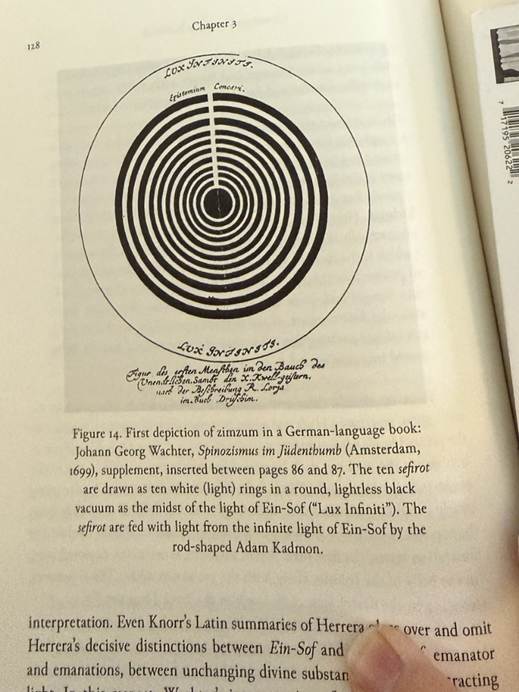
This image, of a dark vacuum being lit by an emanation of light, easily could be read anthropomorphically as an act of procreation. If zimzum is a voluntary act by God to create a first division between itself and not-itself, between light and dark, why not literally between masculine and feminine? Could Zimzum be read as God—recognizing its uniformity as well as its omnipresence and infinity—deciding to divide itself into two differing states that we could interpret as masculine and feminine, thereby disrupting its uniformity? Could zimzum be the reason that humankind consists of Adam and Eve, both made in God’s image (not just man): one masculine that emanates and one feminine that receives, and in their union, creates another? Or how about any gendered act of procreation in the animal kingdom in which it is the egg, content in its wholeness, that must in fact let itself be open to the encounter with a sperm?
But lest we fall into the trap of essentialism and biological determinism, this model resonates in other situations, in which the emanator and the receiver aren’t necessarily of different physical genders. For example, a rabbi can transmit the wisdom of the Kabbalah to his students, but the students must be “fertile” for such teaching to flourish. In turn, the student combines what he received from his teacher with his own insights to produce something new, and might someday transition from student to teacher, thereby inhabiting the feminine and masculine states at different times in their lives. And I could use this gendered reading as a model for an artistic moment of creation, depicting the moment when the artist—whether painter, poet, or musician—evacuates their sense of self, becoming the “feminine,” to receive the “masculine” muse, inspiration, cause, or whatever you want to call it, thereby bringing the painting, poem, or song into being?
I might be mixing my metaphors or confusing my registers, from religion to ethics to anthropology to aesthetics, but in the interest of keeping this blog post at a readable length, I’m going to end with this thought. In having left my religious belief behind a long time ago, I can nevertheless be comforted by the idea of a God willing to humble and diminish itself to make room for the diversity of creation as well as to be understood in a variety of ways.
Favorite bit:
From the Shabbeateans to the Baruch Spinoza controversy to Gershom Scholem’s utmost zimzum to “McMysticism,” there are a lot of possibilities for a favorite bit. But as I was reading the first few chapters that methodically explained zimzum and related concepts through close readings of foundational texts, I found myself asking why. Why did God contract itself? My favorite answer came from Israel Sarug. In his account, prior to the first intentional act of zimzum, there is an act of self-development within Ein-Sof (or God) that is not willful. Instead, Sarug says that Ein-Sof possessed an “inner delight” (as translated by Schulte) in itself. And quoting Schulte further: “Like the laughter of man, this delight releases a very slight shaking or reverberation. . . . This inner pleasure of the parts of Ein-Sof in and with itself releases the slight vibration, the power of din, the power of austerity and limitation that originally existed in undivided and unmoved harmony with the opposite power of the loving, overflowing compassion, rachamim.” And this is not my favorite bit just because on a surface level it could easily be read to support my gendered reading of zimzum above. It’s my favorite bit because it reminds me of a story from the Old Testament, when Abraham tells his wife Sarah that God told him she would give birth, even though she was already 80 years old. Her reaction was to laugh, although she denied it later because she was afraid. And I’d like to believe that, in that moment, she laughed not because she was too old to have a child but because she, like Ein-sof (or at least in its image), was already in possession of an inner delight of herself and didn’t need a child. But, because she laughed, she was making room nonetheless for the possibility of pro/creation.